What async/await actually does under the hood
async/await looks like sequential code but runs very differently. Understanding event loops and suspension points explains the performance — and the pitfalls.
async/await exists in JavaScript, Python, C#, Rust, Swift and Kotlin. The syntax hides a simple idea: a function that can pause while it waits, letting other work run on the same thread.
The event loop
An event loop is a scheduler. It holds tasks that are ready to run and tasks waiting for something — a network response, a timer. It runs ready tasks one at a time; when a task hits await on something not yet available, the task is suspended and the loop moves on.
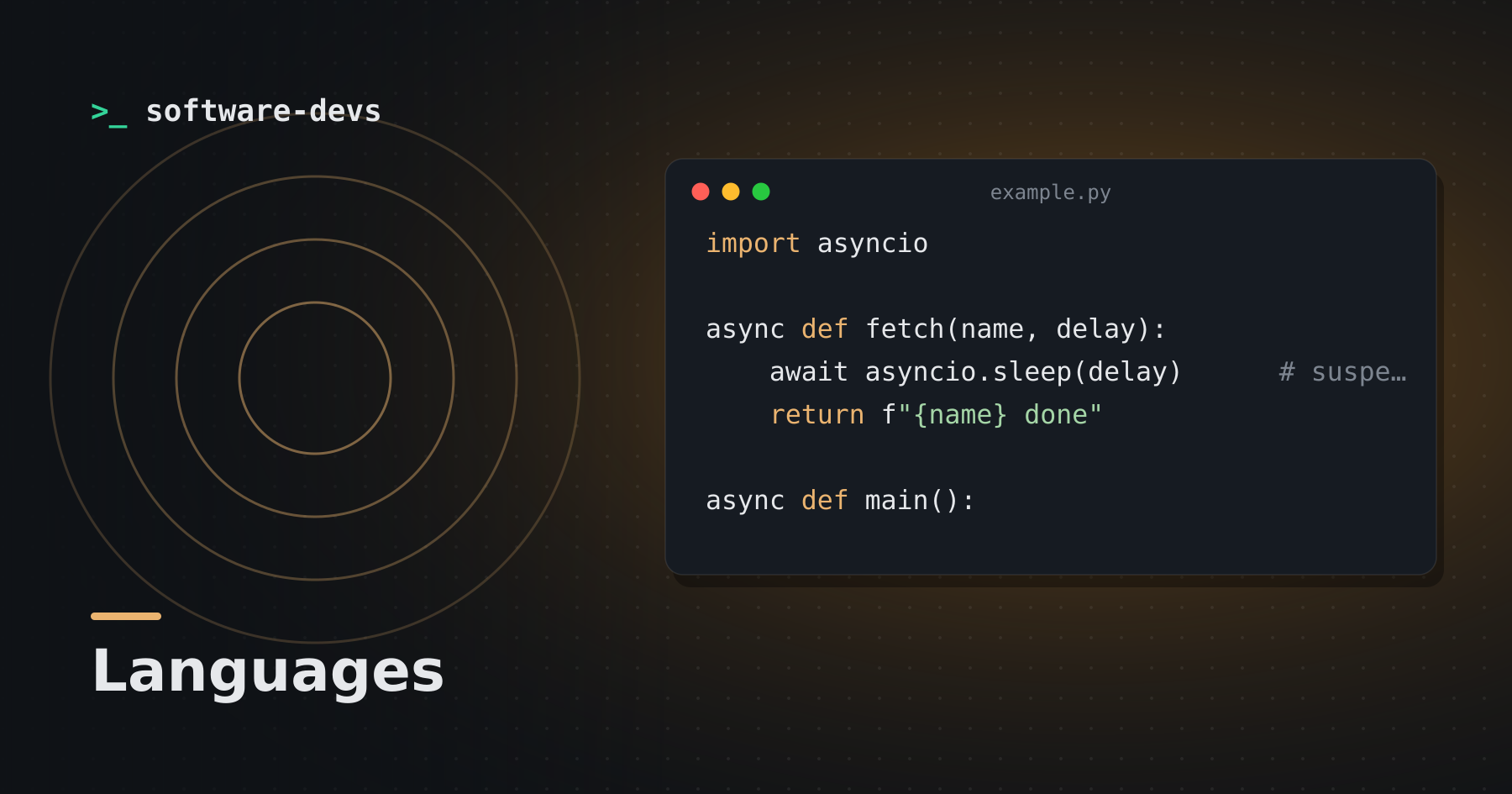
import asyncio

async def fetch(name, delay):
    await asyncio.sleep(delay)      # suspension point
    return f"{name} done"

async def main():
    results = await asyncio.gather(fetch("a", 1), fetch("b", 1))
    print(results)                  # ~1 second total, not 2

asyncio.run(main())
Async functions become state machines
Compilers and runtimes transform an async function into an object that remembers where it paused and what its local variables were. Each await is a point where it can yield control and later resume. No extra threads are involved.
Concurrency is not parallelism
Async lets one thread juggle many waiting tasks. It doesn't run CPU-heavy work in parallel. A long computation inside an async function blocks the whole loop — every other task freezes until it finishes.
Common pitfalls
- Blocking calls inside async code: a synchronous HTTP library or
time.sleepstalls everything. Use async-aware libraries, or push blocking work to a thread pool. - Forgetting to await: you get a coroutine or promise object instead of a result, and errors may vanish silently.
- Sequential awaits when you meant concurrent ones:
await a(); await b()runs one after the other. Usegather,Promise.allor the equivalent. - Function coloring: async functions can generally only be awaited from other async functions, which spreads
asyncthrough a codebase.
When async pays off
I/O-bound workloads with many concurrent waits: web servers, crawlers, chat systems, API gateways. For CPU-bound work, reach for processes, threads or a language with true parallelism instead.