Unicode for programmers: bytes, code points and graphemes
Asking for the length of a string has at least three correct answers. Understanding why prevents a family of text-handling bugs.
Text looks simple until it isn't: a name truncated mid-character, an emoji counted as two letters, a search that misses "café" because of how the é was typed. The fix starts with knowing the layers.
Three levels
- Bytes: how text is stored or sent. UTF-8 uses 1 to 4 bytes per code point.
- Code points: the numbered characters in the Unicode standard, like U+0065 for "e".
- Grapheme clusters: what a human perceives as one character — which may be several code points.
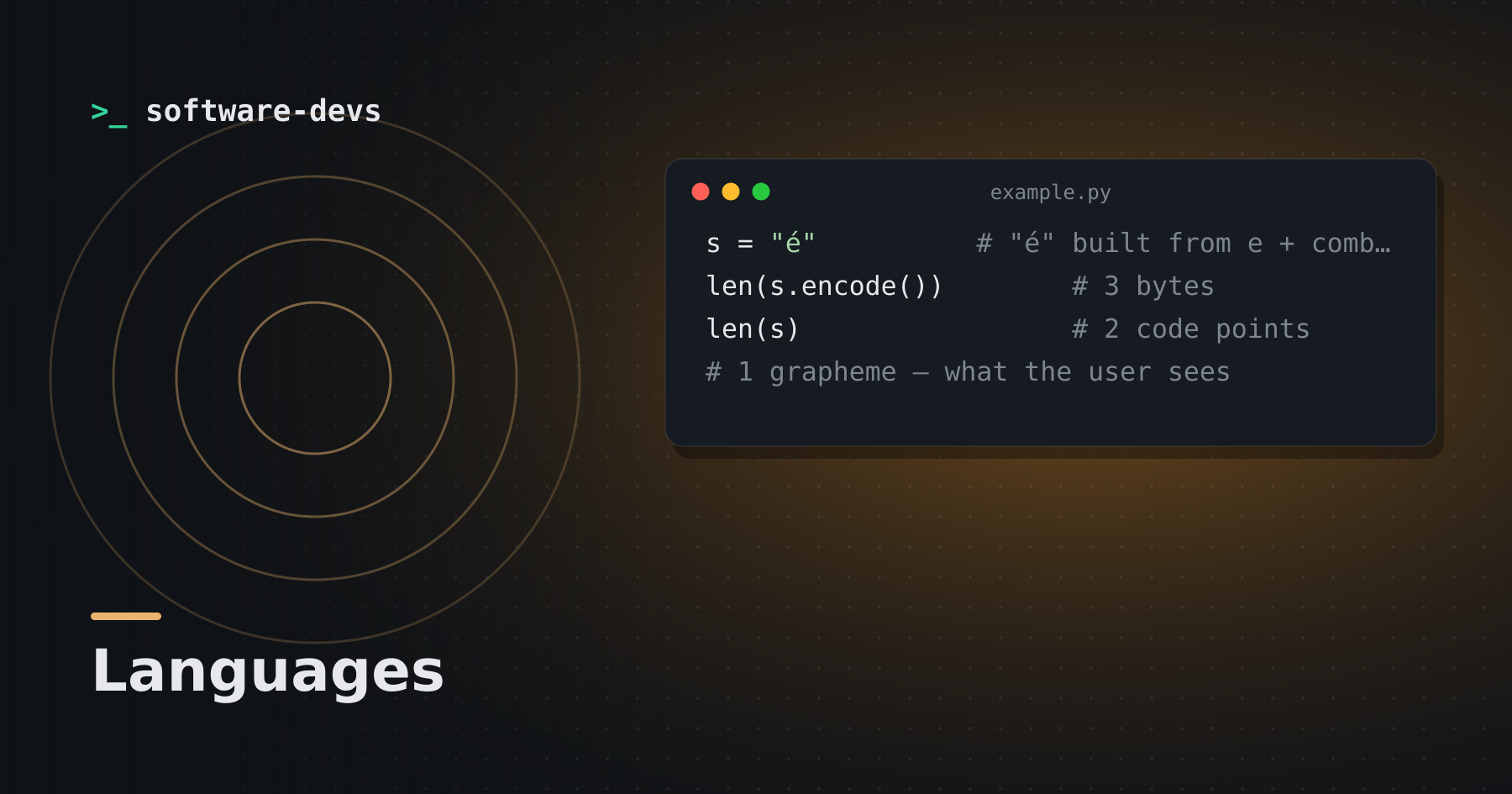
s = "é"          # "é" built from e + combining accent
len(s.encode())        # 3 bytes
len(s)                 # 2 code points
# 1 grapheme — what the user sees
Emoji make this vivid: a family emoji or a flag can be several code points joined together, but it's one visible symbol.
Normalization
"é" can be one code point (U+00E9) or two (e + U+0301). They look identical but compare unequal. Normalize before comparing or storing:
import unicodedata
unicodedata.normalize("NFC", s) == "é"   # True
NFC composes characters where possible and is a good default for storage.
Common bugs
- Truncating by bytes or code points can split a character or an emoji. Truncate by grapheme clusters for user-visible text.
- Case-insensitive comparison isn't just
lower(). Some languages have special casing rules; use proper case folding. - Database column limits may count bytes, not characters.
- Reversing strings code point by code point breaks combining marks.
Practical rules
- Use UTF-8 everywhere — files, databases, HTTP.
- Decode bytes to text at the edges of your program; work with text inside.
- Normalize user input you'll compare or search.
- Use a library that understands grapheme clusters for display-length operations.
Most text bugs come from treating one layer as another. Keep them straight and Unicode becomes much less mysterious.