Threat modeling for small teams in an afternoon
You don't need a security department to think like an attacker. A lightweight, repeatable session finds the risks worth fixing before they ship.
Threat modeling sounds like something for banks and governments. In practice, it's a structured conversation about four questions — and a small team can do it in an afternoon.
The four questions
- What are we building?
- What can go wrong?
- What are we going to do about it?
- Did we do a good job?
Step 1: draw it
Sketch the system: users, services, databases, third-party APIs and the data flowing between them. Mark trust boundaries — places where data crosses from less trusted to more trusted, like the internet into your API, or your app into a payment provider.
Step 2: walk the boundaries with STRIDE
For each boundary, run through six categories:
| Letter | Threat | Example question |
|---|---|---|
| S | Spoofing | Can someone pretend to be another user or service? |
| T | Tampering | Can data be modified in transit or at rest? |
| R | Repudiation | Could someone deny an action because we don't log it? |
| I | Information disclosure | Can data leak to someone who shouldn't see it? |
| D | Denial of service | Can someone exhaust a resource? |
| E | Elevation of privilege | Can a user gain permissions they shouldn't have? |
Step 3: write it down
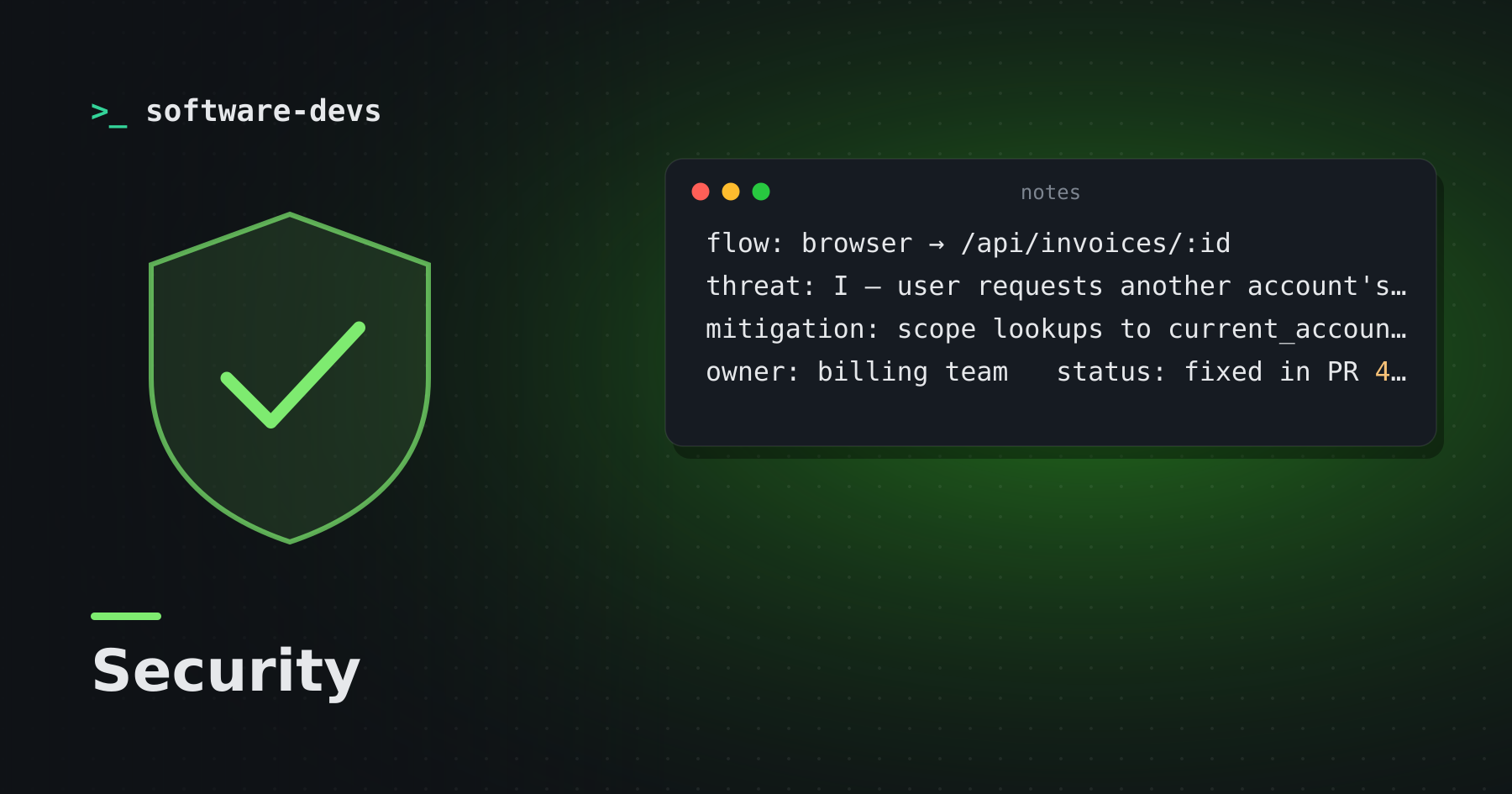
flow: browser → /api/invoices/:id
threat: I — user requests another account's invoice by changing the ID
mitigation: scope lookups to current_account.invoices
owner: billing team   status: fixed in PR 482
Rank threats by likelihood and impact, fix the important ones and accept the rest knowingly.
Step 4: repeat
Revisit the model when you add a feature that crosses a trust boundary: a new integration, file uploads, a public API, an admin tool.
Tips
- Include someone who didn't build the feature — fresh eyes find assumptions.
- Keep it short. A one-page model that gets updated beats a perfect one that doesn't.
- Feed findings into normal tickets so they actually get done.
The goal isn't to find every possible attack. It's to make sure the obvious ones were considered on purpose.