SLOs and error budgets: deciding how reliable is reliable enough
100% uptime is the wrong goal. Service level objectives turn reliability into a number you can plan around, and error budgets tell you when to slow down.
"The site should never go down" isn't a goal — it's a wish, and chasing it makes every change feel dangerous. Service level objectives (SLOs) replace it with an explicit, measurable target.
The vocabulary
- SLI (indicator): a measurement of user experience, such as the fraction of requests that succeed quickly.
- SLO (objective): the target for that measurement over a time window.
- Error budget: the amount of unreliability the SLO permits.
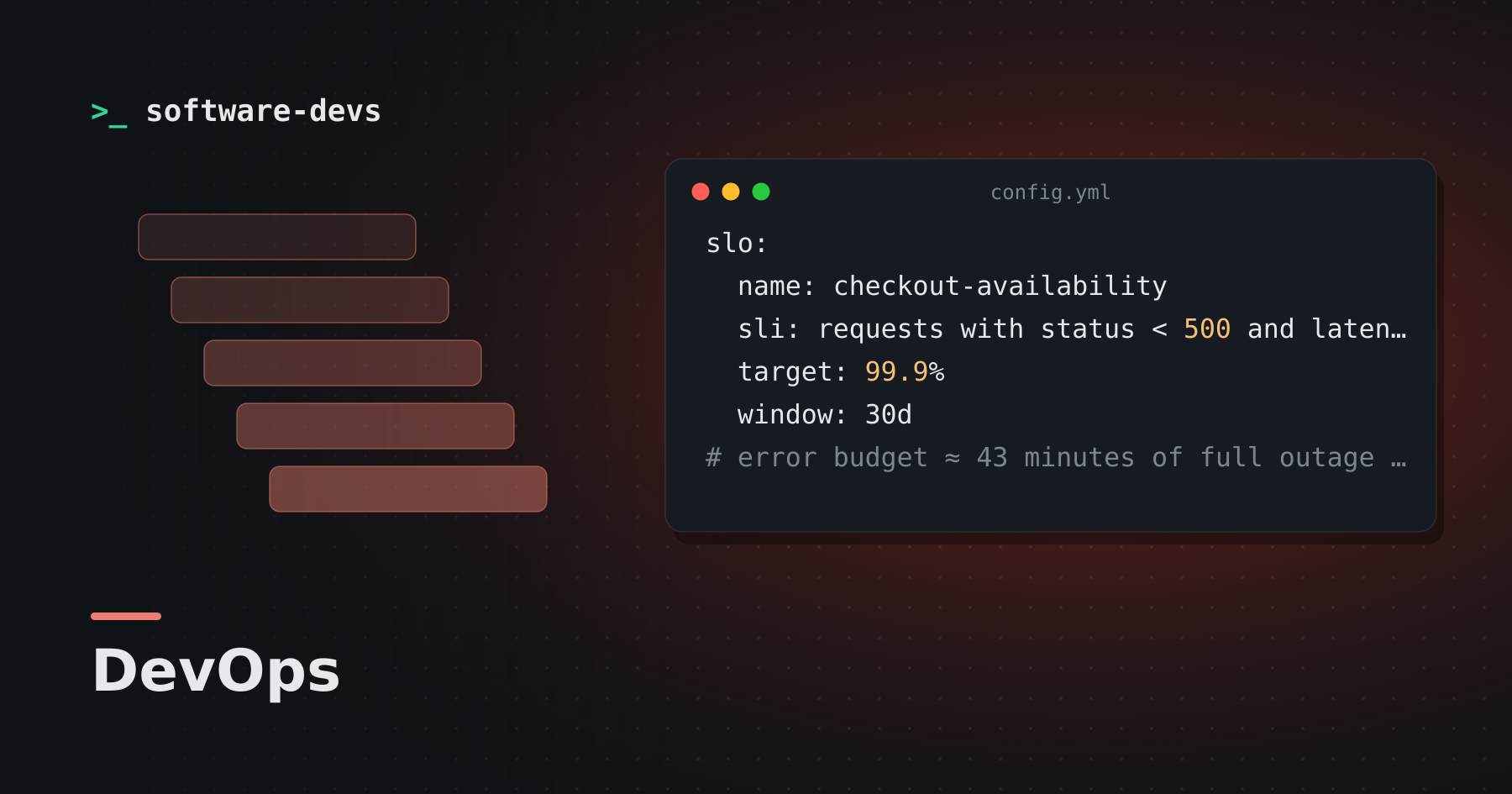
slo:
  name: checkout-availability
  sli: requests with status < 500 and latency < 500ms
  target: 99.9%
  window: 30d
# error budget ≈ 43 minutes of full outage per 30 days
Choosing SLIs
Measure what users feel, as close to them as possible:
- Availability: did the request succeed?
- Latency: did it succeed fast enough?
- Freshness: is the data shown recent enough?
CPU usage and memory are useful for debugging, but they aren't SLIs — users don't experience them directly.
Picking a target
Each extra nine costs dramatically more. Your users probably can't tell 99.95% from 99.99%, especially if their own network fails more often than that. Start with something you currently achieve, then tighten if users need it.
Spending the budget
The error budget is what makes SLOs useful:
- Budget remaining: ship features, run experiments, take reasonable risks.
- Budget exhausted: slow down, focus on reliability work until you recover.
This turns the eternal argument between "ship faster" and "be careful" into a shared, data-driven rule.
Alerting on burn rate
Instead of paging on every error spike, alert when the budget is being consumed too fast — for example, at a rate that would exhaust a month's budget in a couple of days. That catches real incidents and ignores harmless blips.
Start with one
Pick your most important user journey — login, checkout, search — define one SLO, put it on a dashboard and review it monthly. That alone changes how a team talks about reliability.