Pattern matching across languages: Ruby, Python and Rust compared
Pattern matching has spread from functional languages into the mainstream. The syntax differs, but the idea — destructure and branch on shape — is the same.
Pattern matching lets you check the shape of a value and pull it apart in one step. Once niche, it's now available in Ruby, Python, Rust, C#, Java and more.
Rust: exhaustive by default
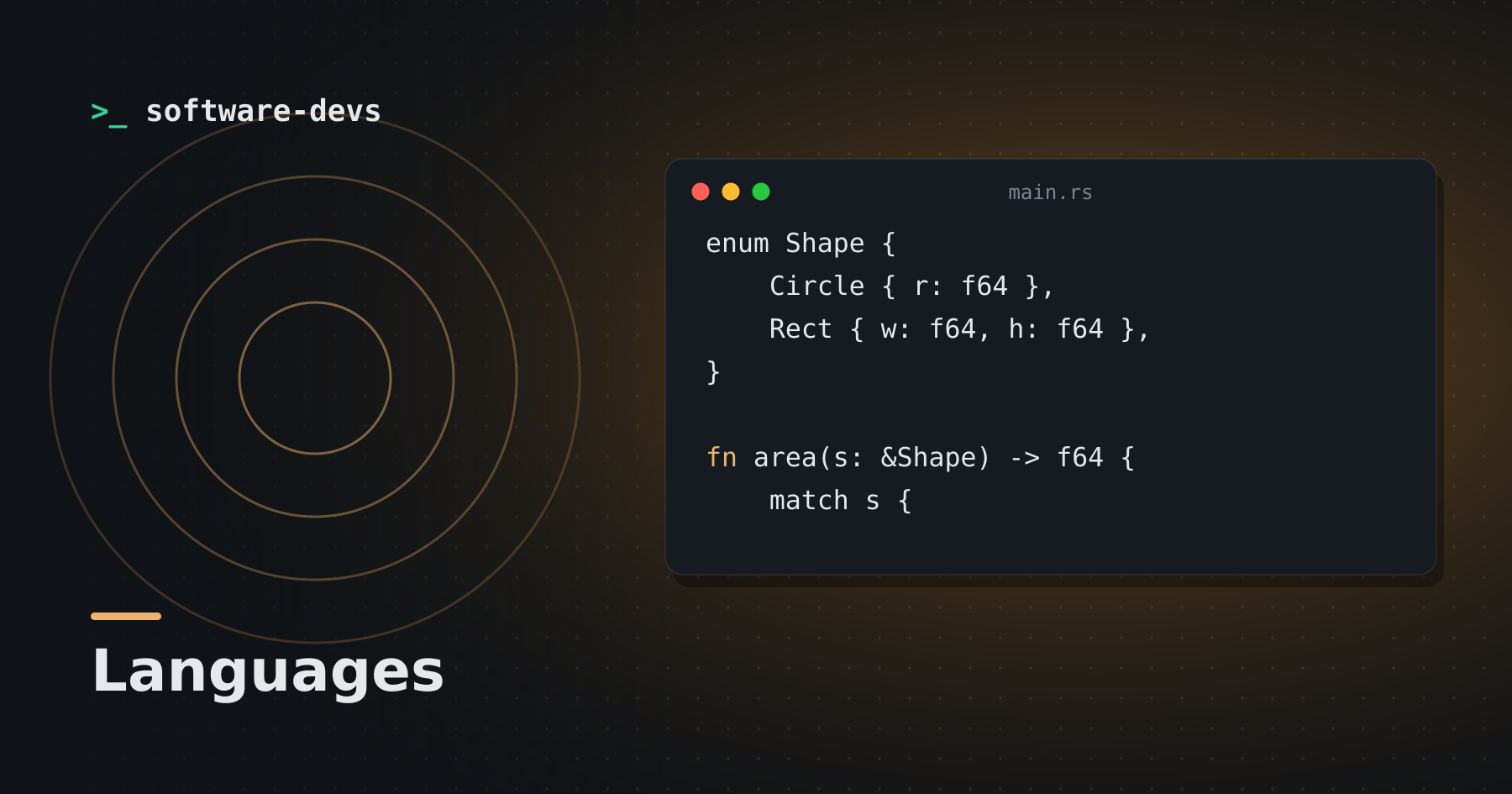
enum Shape {
    Circle { r: f64 },
    Rect { w: f64, h: f64 },
}

fn area(s: &Shape) -> f64 {
    match s {
        Shape::Circle { r } => std::f64::consts::PI * r * r,
        Shape::Rect { w, h } => w * h,
    }
}
Add a Triangle variant and the compiler flags every match that doesn't handle it. That exhaustiveness check is pattern matching's killer feature in statically typed languages.
Python: structural pattern matching
match event:
    case {"type": "click", "x": x, "y": y}:
        handle_click(x, y)
    case {"type": "key", "key": "Escape"}:
        close_dialog()
    case _:
        pass
Python matches dictionaries, sequences and class instances, binding names as it goes. There's no exhaustiveness check at runtime, so a final case _: is good practice.
Ruby: case/in
case response
in { status: 200, body: { user: { name: String => name } } }
  puts "Hello, #{name}"
in { status: 404 }
  puts "Not found"
end
Ruby raises NoMatchingPatternError if nothing matches and there's no else, which makes missing cases loud.
Shared ideas
- Destructuring: pull fields out while matching.
- Guards: add conditions —
if x > 0in Rust and Python,ifin Ruby. - Wildcards:
_matches anything. - Literal and type patterns: match exact values or classes.
When it shines
Parsing JSON-like data, handling tagged unions or result types, interpreting commands and implementing state machines. It replaces chains of if statements and type checks with something that reads like a description of the data.
When it doesn't
For a simple equality check, a plain if is clearer. Pattern matching earns its keep when data has structure worth describing.