Immutability and persistent data structures for everyday developers
Data that never changes is easier to reason about, share and test. Persistent data structures make immutability practical without copying everything.
A huge class of bugs comes from one piece of code changing data another piece of code was still using. Immutability removes that class entirely: once created, a value never changes. To "modify" it, you create a new value.
Immutability in practice
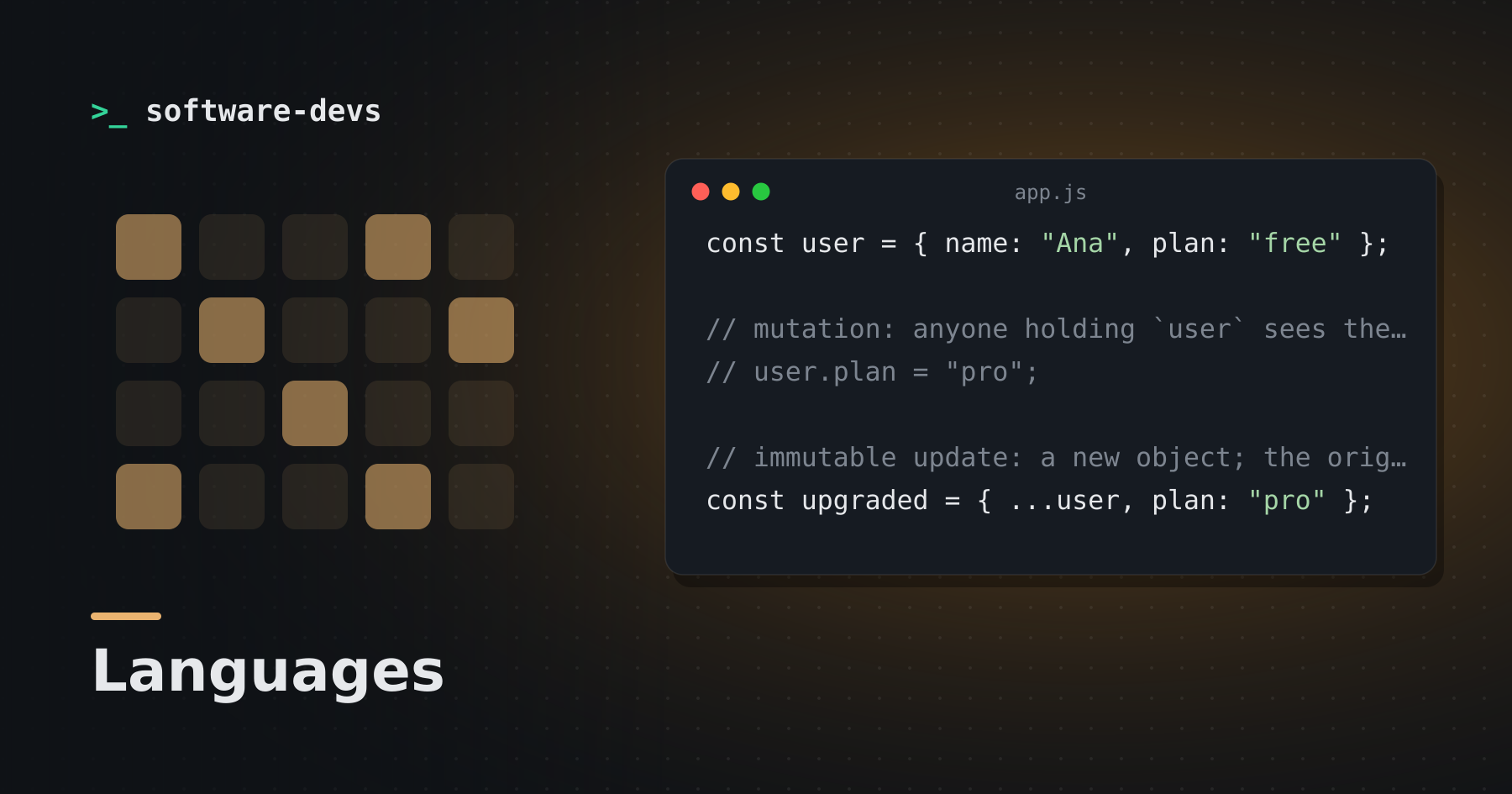
const user = { name: "Ana", plan: "free" };

// mutation: anyone holding `user` sees the change
// user.plan = "pro";

// immutable update: a new object; the original is untouched
const upgraded = { ...user, plan: "pro" };
Many languages support this directly: frozen objects and strings in Ruby, tuples and frozen dataclasses in Python, final and records in Java, and immutability by default in Rust, Elixir and Clojure.
Why it helps
- Reasoning: a value you were handed can't change behind your back.
- Concurrency: immutable data can be shared across threads without locks.
- Change detection: "did it change?" becomes a cheap reference comparison, which UI frameworks rely on.
- Undo and history: keep old versions around for free.
Isn't copying expensive?
Copying a million-element list to change one item would be. Persistent data structures avoid that through structural sharing: the new version reuses most of the old version's internal nodes and only allocates the path that changed.
old vector:   [root] → [a][b][c][d]
new vector:   [root'] → [a][b][c'][d]
                  shared: a, b, d   new: root', c'
Tree-based vectors and maps make updates cost roughly logarithmic time and memory instead of linear.
Where to apply it
You don't need a purely functional language to benefit:
- Treat function arguments as read-only.
- Use value objects for things like money, dates and coordinates.
- Keep shared configuration and caches immutable.
- In UI state management, return new state instead of mutating.
The trade-off
Immutable updates allocate more, and hot loops over large data can be faster with careful mutation. The pragmatic approach: immutable by default, mutable where profiling says it matters — and keep that mutation local.