Generics explained: one idea, three implementations
Generics let you write code once for many types without giving up type safety. TypeScript, Go and Rust each approach them differently.
Without generics, you either write maxInt, maxFloat and maxString, or you accept "any" type and lose compile-time checking. Generics let you write the logic once, parameterized by type.
Go: type parameters with constraints
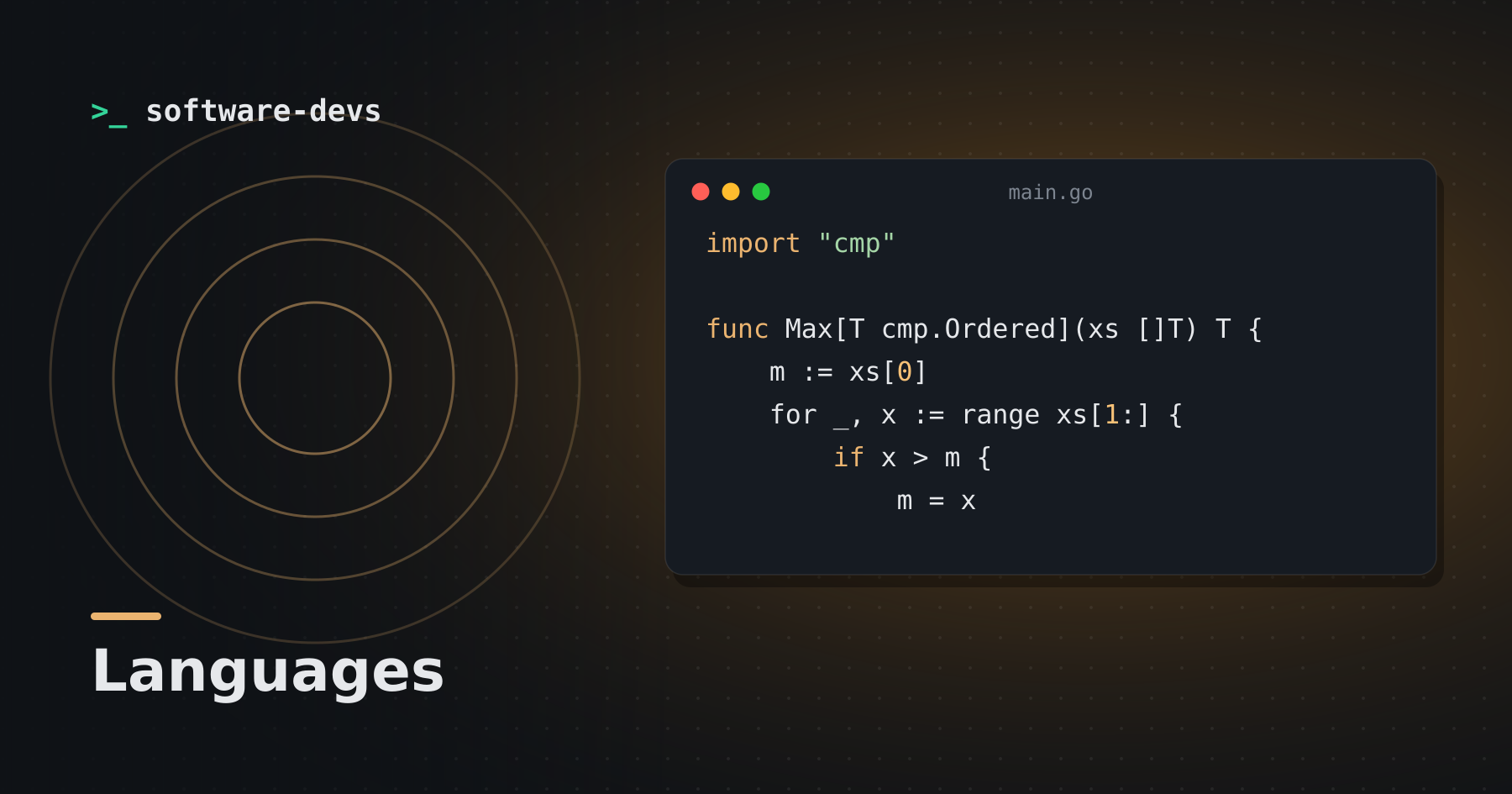
import "cmp"

func Max[T cmp.Ordered](xs []T) T {
    m := xs[0]
    for _, x := range xs[1:] {
        if x > m {
            m = x
        }
    }
    return m
}

Max([]int{3, 9, 2})          // 9
Max([]string{"b", "a"})      // "b"
The constraint cmp.Ordered says T must support < and >.
TypeScript: generics with structural typing
function first<T>(items: T[]): T | undefined {
  return items[0];
}

function longest<T extends { length: number }>(a: T, b: T): T {
  return a.length >= b.length ? a : b;
}
TypeScript's types disappear at runtime; generics exist purely for the type checker.
Rust: traits as bounds
fn largest<T: PartialOrd + Copy>(xs: &[T]) -> T {
    let mut m = xs[0];
    for &x in xs { if x > m { m = x; } }
    m
}
How they're implemented
- Monomorphization (Rust, C++): the compiler generates a specialized copy for each concrete type. Fast at runtime, larger binaries and slower compiles.
- Type erasure (Java, TypeScript): generic types are checked at compile time and erased afterwards. One implementation, less runtime type information.
- Hybrid approaches (Go): implementations may share code across types with similar memory shapes, balancing binary size and speed.
When to use them
Collections, utilities like map and filter, caches and repository layers are natural fits. If a function only ever handles one type, a generic version adds noise. A good rule: write the concrete version first, and generalize when the second or third type shows up.