Compilers 101: from source code to running program
Every language implementation follows a recognizable pipeline. Knowing the stages makes error messages, tooling and performance easier to understand.
Whether it's a C compiler, a JavaScript engine or the tool that runs your SQL, language implementations share a common shape. Understanding it demystifies everything from syntax errors to "why is the first call slower?"
1. Lexing
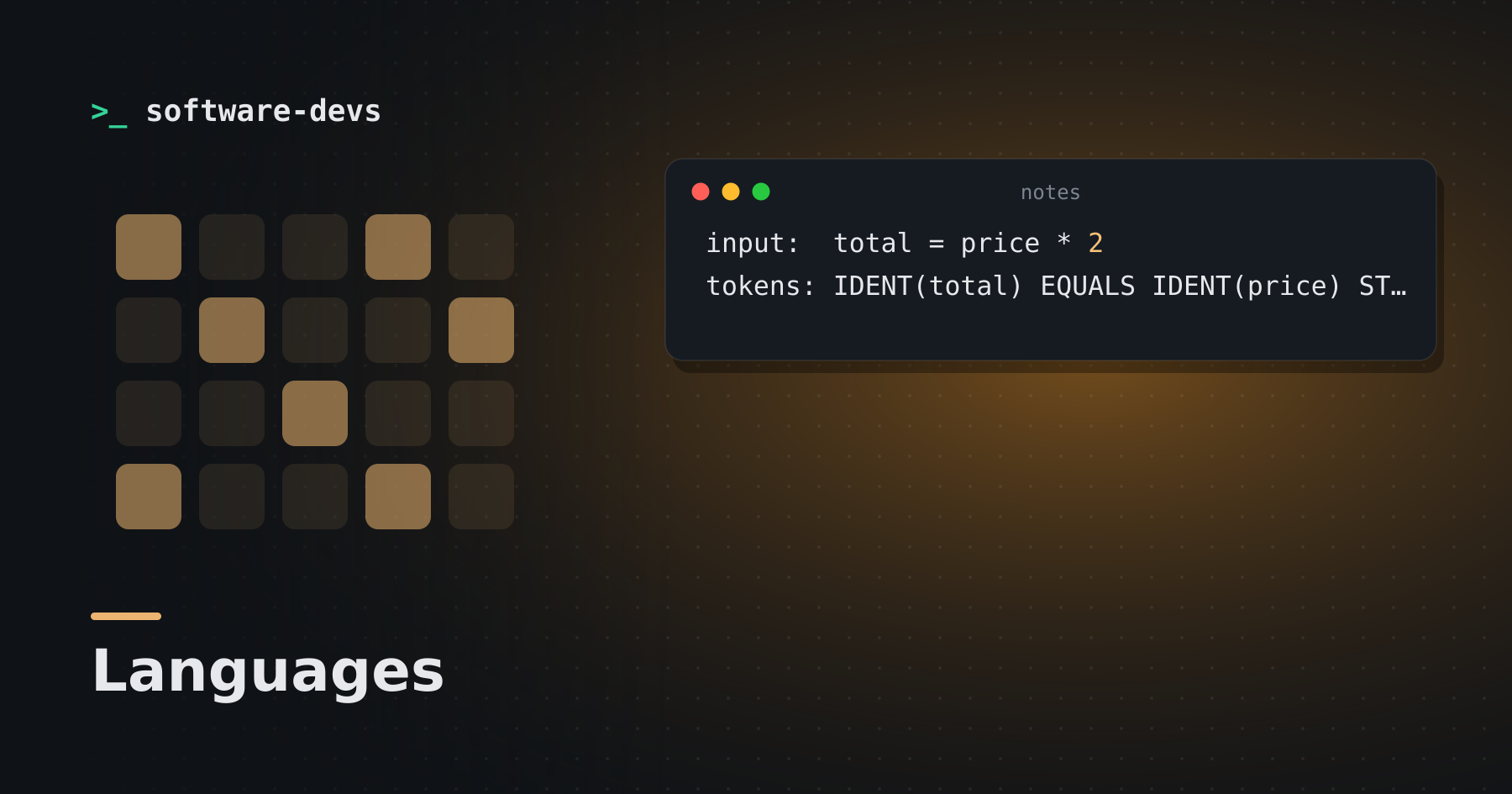
The lexer turns raw characters into tokens:
input:  total = price * 2
tokens: IDENT(total) EQUALS IDENT(price) STAR NUMBER(2)
Whitespace and comments usually disappear here.
2. Parsing
The parser arranges tokens into an abstract syntax tree (AST) according to the grammar, respecting precedence — * binds tighter than +.
Assign
├── total
└── Multiply
    ├── price
    └── 2
Syntax errors come from this stage. Linters, formatters and editors work on the AST too.
3. Semantic analysis
Name resolution (which price is this?), type checking and other rules the grammar can't express. "Undefined variable" and "type mismatch" errors come from here.
4. Intermediate representation
The AST is lowered into a simpler, more uniform IR that's easier to analyze and optimize — often a list of simple instructions or a control-flow graph.
5. Optimization
Constant folding (2 * 3 becomes 6), dead code elimination, inlining small functions and moving work out of loops.
6. Code generation
Finally: machine code for a specific CPU, bytecode for a virtual machine, or even another language.
Interpreters and JITs
- Interpreters execute the AST or bytecode directly.
- JIT compilers start by interpreting, watch which code runs hot, then compile those parts to machine code at runtime — which is why many runtimes get faster after warming up.
Why it's worth knowing
Better error messages make sense once you know which stage produced them. Tools like linters and codemods become approachable. And writing a tiny interpreter for a calculator or config language is one of the most rewarding weekend projects a developer can take on.