Transaction isolation levels without the jargon
Your database lets concurrent transactions see each other in controlled ways. Knowing which anomalies your isolation level allows prevents subtle, expensive bugs.
Two requests update the same account balance at the same moment. What each one sees depends on the transaction's isolation level — and the default is often weaker than people assume.
The anomalies
- Dirty read: you see another transaction's uncommitted changes.
- Non-repeatable read: you read a row twice in one transaction and get different values.
- Phantom read: you run the same query twice and new rows appear.
- Lost update: two transactions read a value, both modify it, and one overwrite silently wins.
The levels
| Level | Prevents |
|---|---|
| Read uncommitted | (almost nothing) |
| Read committed | Dirty reads |
| Repeatable read | + non-repeatable reads |
| Serializable | All of the above — behaves as if transactions ran one at a time |
Exact behavior varies by database. Postgres, for example, defaults to read committed, and its repeatable read also prevents phantoms.
The classic bug
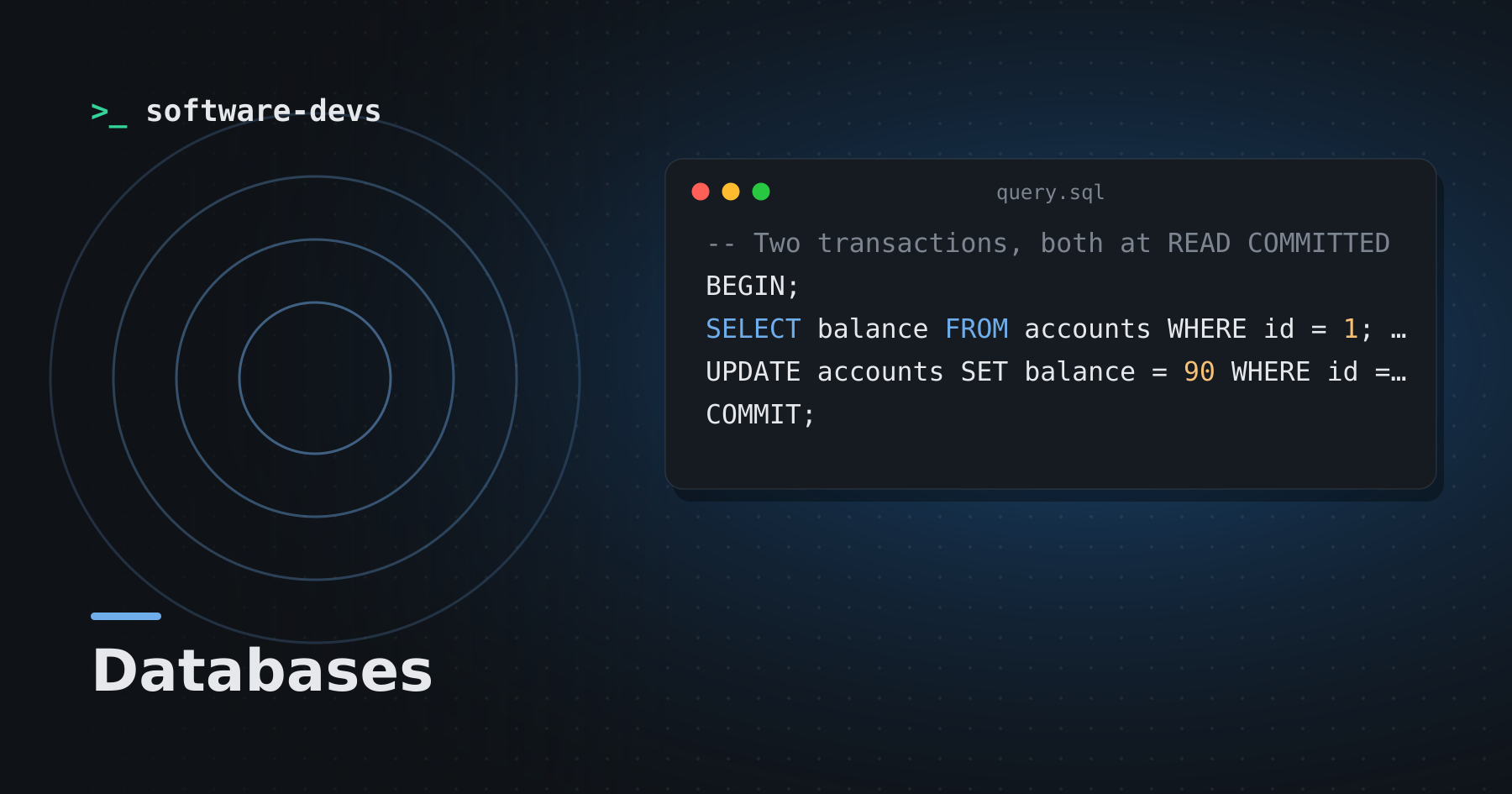
-- Two transactions, both at READ COMMITTED
BEGIN;
SELECT balance FROM accounts WHERE id = 1;   -- both read 100
UPDATE accounts SET balance = 90 WHERE id = 1;  -- app computed 100 - 10
COMMIT;
Both withdraw 10, but the balance ends at 90, not 80. A lost update.
Fixes, from simplest
- Do the math in SQL:
UPDATE accounts SET balance = balance - 10 WHERE id = 1. The database applies each update to the latest value. - Lock the row:
SELECT ... FOR UPDATEmakes the second transaction wait for the first. - Optimistic locking: add a
versioncolumn and include it in theWHEREclause; if zero rows update, someone else changed it — retry. - Serializable isolation: the database detects conflicts and aborts one transaction, which your code must retry.
Practical advice
Keep transactions short, push arithmetic into the database where you can, and use row locks or optimistic locking for read-modify-write flows. Reach for serializable when correctness matters more than throughput — and always write the retry loop.