The case for boring technology
Every new technology you adopt spends some of your team's limited capacity for novelty. Spend it where it differentiates your product.
New tools are exciting. But every technology you adopt comes with unknowns: failure modes nobody on the team has seen, gaps in documentation, upgrade surprises. Choosing "boring" — mature, well-understood — technology isn't a lack of ambition. It's a budget decision.
Innovation tokens
A useful mental model: each team gets a small number of "innovation tokens" to spend on unfamiliar technology. Spend one on a new database, a new language or a new deployment platform, and that's one fewer for the thing that makes your product unique.
What "boring" buys you
- Known failure modes. Someone has already hit your bug and written about it.
- Hiring. More people already know it.
- Ecosystem. Libraries, monitoring integrations and hosting options exist.
- Stability. Fewer breaking changes and abandoned dependencies.
Write the decision down
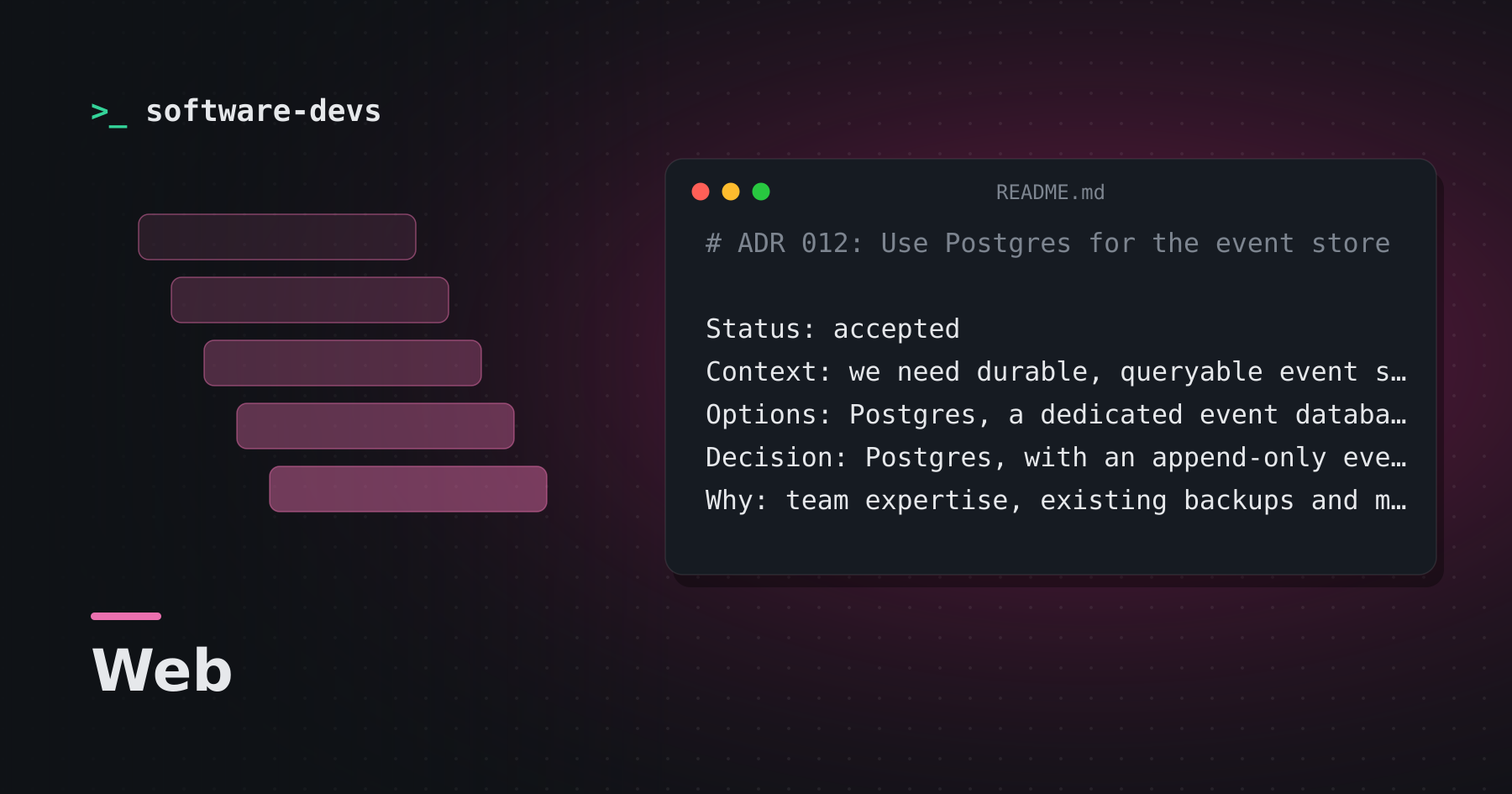
A short architecture decision record keeps the reasoning visible:
# ADR 012: Use Postgres for the event store

Status: accepted
Context: we need durable, queryable event storage
Options: Postgres, a dedicated event database, a streaming platform
Decision: Postgres, with an append-only events table
Why: team expertise, existing backups and monitoring, adequate scale
Revisit if: write volume exceeds what one primary can handle
When new technology is the right call
- It solves a problem your current tools genuinely can't.
- It's core to your product's differentiation.
- The team is prepared to own it — operate it, debug it and upgrade it.
Questions to ask first
- Can we solve this with what we already run, even if it's less elegant?
- Who will be paged when it breaks at 3 a.m.?
- What does it take to remove it if it doesn't work out?
The point
Boring technology lets you spend your creativity on your users' problems instead of your infrastructure's. The most exciting products are often built on the least exciting stacks.