How to get real value from AI code review
AI reviewers are good at catching certain classes of bugs and terrible at others. Teams that benefit treat them as a first pass, not a gatekeeper.
AI-assisted code review has gone from novelty to default in many teams. The results vary wildly. The difference is rarely the model — it's how the team uses it.
Where AI review shines
- Mechanical bugs: off-by-one errors, unchecked
nil, swapped arguments, missingawait. - Consistency: naming, error-handling patterns, forgotten logging.
- Reading the boring parts: large diffs where human attention fades.
Where it struggles
- Intent. It can't know the ticket said "only admins" unless you tell it.
- System-wide effects. A change that's locally correct but breaks an invariant three services away.
- Taste. Whether an abstraction is worth it is a team decision.
A workflow that works
- Run the AI pass before requesting human review, so obvious issues are fixed first.
- Give it context: the issue description, relevant docs, and project conventions.
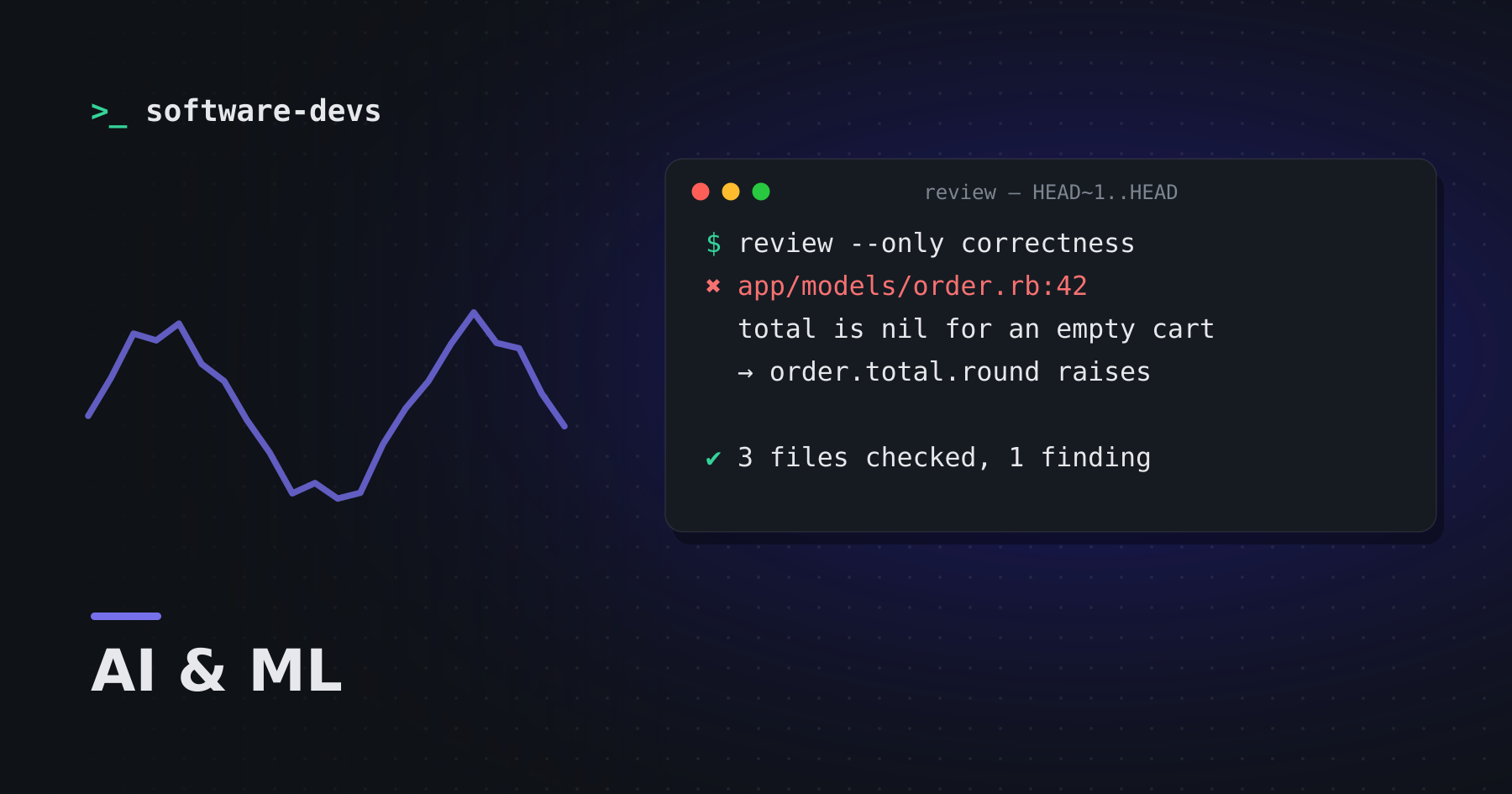
- Ask for findings with failure scenarios — "this breaks when X" — not style opinions.
- Keep a human as the approver for anything that touches security, money or data.
Review this diff for correctness bugs only.
For each finding, give the input that triggers it and the wrong result.
Skip style comments.
Measure it
Track how many AI findings are accepted versus dismissed. If most are dismissed, tighten the prompt or narrow the scope. Noise is the fastest way to get a tool ignored.