Before you ship an LLM feature, build an eval set
LLM features fail in ways unit tests don't catch. A few dozen labeled examples and a repeatable scoring script turn "it seems fine" into evidence.
Traditional code is deterministic: same input, same output, and a unit test pins it down. LLM-powered features are probabilistic, sensitive to prompt wording and can change behavior when you switch models. "I tried it a few times and it looked good" is not a release criterion.
What an eval set is
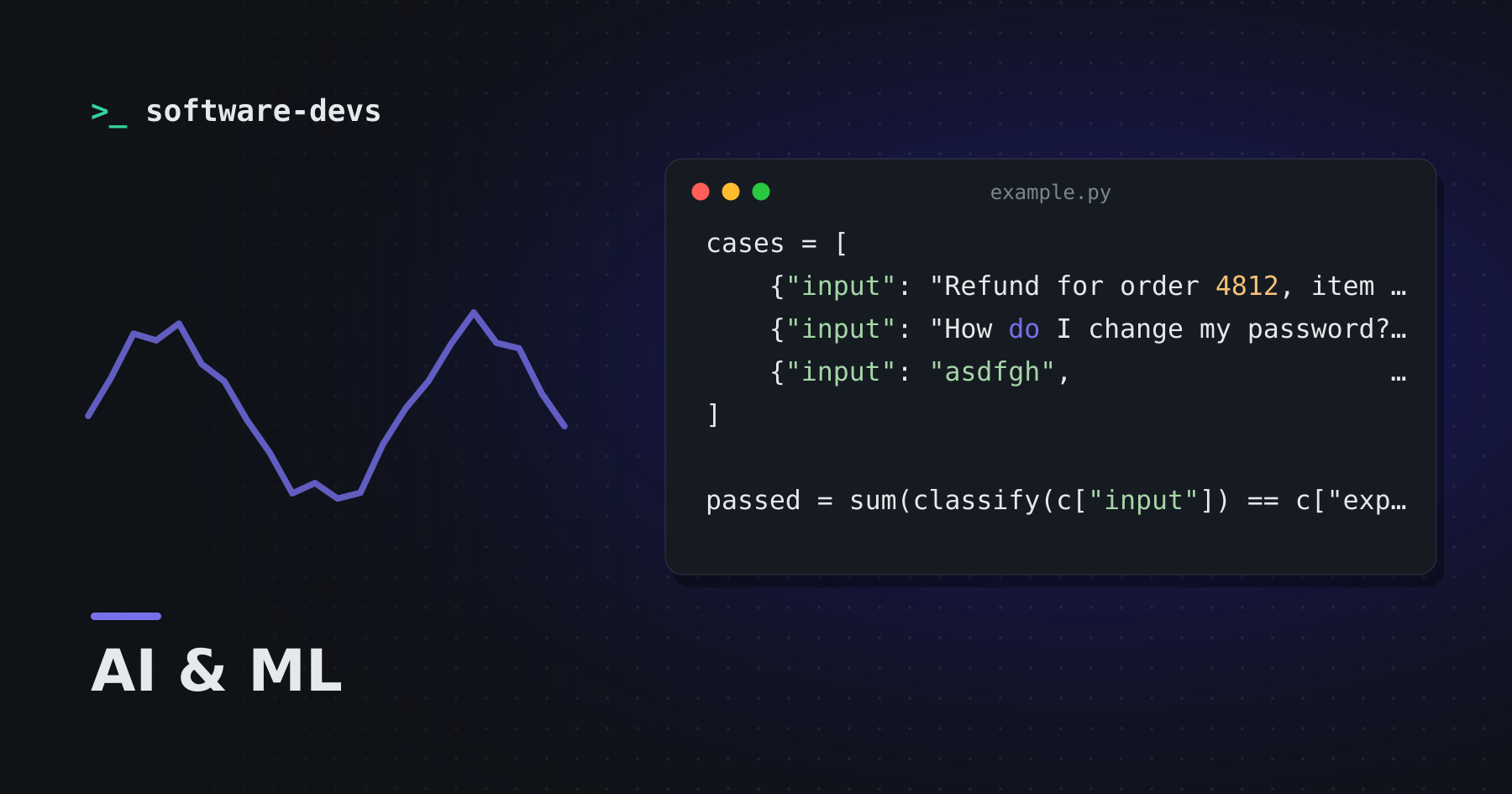
A collection of realistic inputs with a way to judge each output:
cases = [
    {"input": "Refund for order 4812, item arrived broken", "expect_intent": "refund"},
    {"input": "How do I change my password?",             "expect_intent": "account"},
    {"input": "asdfgh",                                    "expect_intent": "unknown"},
]

passed = sum(classify(c["input"]) == c["expect_intent"] for c in cases)
print(f"{passed}/{len(cases)} correct")
Building one
- Start with real data. Pull examples from logs, support tickets or user research — not inputs you invented to make the feature look good.
- Cover the edges. Empty input, very long input, other languages, adversarial attempts, ambiguous requests.
- Start small. Thirty to fifty well-chosen cases catch most regressions. Grow it as you find failures.
- Add every bug. When a user reports a bad answer, it becomes a new case.
Scoring
- Exact match works for classification and extraction.
- Programmatic checks work for structure: valid JSON, required fields present, length limits.
- Model-graded scoring — asking a model to judge against a rubric — helps for open-ended text, but spot-check its judgments against your own.
- Human review of a sample remains the ground truth.
Use it like a test suite
Run the eval on every prompt change and every model upgrade, and track the score over time. A prompt tweak that fixes one complaint and silently breaks five other cases is the most common LLM regression — and an eval set is how you see it.
The real benefit
Evals turn arguments about whether a change is "better" into numbers. That makes it safe to iterate quickly, swap models when a cheaper one is good enough and ship with confidence instead of hope.